How Do I Know If My Homeschooled Child Is On Track?
Am I teaching enough?
Are we missing something?
Should they already know this?
How do I actually know if my child is on track?
If you homeschool, chances are you've asked yourself at least one of these questions... Maybe all four.
Maybe all four before you've even finished your first cup of coffee.
One of the beautiful things about homeschooling is the freedom it gives us. We can slow down when our kids need more time. We can move ahead when they're ready. We can follow an unexpected question down a rabbit trail, spend an afternoon outside, turn dinner into a math lesson, or ditch the workbook altogether when something isn't working.
But that freedom can also leave us wondering:
How do I know we're actually covering what matters?
As a former teacher turned homeschool mom, this is one of the things I think about a lot. Because I don't want to recreate a traditional classroom in my home—but I do want to know that my kids are building the skills they'll need as they continue learning.
And those two things can exist together. You can protect the freedom and joy of homeschooling and have a clear picture of what your child is learning.
Here's where I would start.
First, What Does “On Track” Actually Mean?
Before we talk about standards, checklists, or grade levels, we need to clear something up: Being “on track” doesn't mean every child learns every skill at exactly the same time. Kids aren't assembly-line products.
One second grader may fly through chapter books but need more time with subtraction. Another may understand math concepts quickly but still be working on reading fluency. That's one of the advantages we have as homeschool parents. We get to see the whole child.
Instead of asking only: “Is my child exactly where every other second grader is?”
I think there are better questions:
What can my child do now that they couldn't do six months ago?
Which skills are becoming easier?
Where are they still struggling?
Can they use what they've learned outside of a worksheet?
What are they ready to learn next?
That's progress. And progress gives us much more useful information than simply checking whether we finished page 127 of a curriculum.
Standards Can Be a Tool—Not Your Curriculum
I know the word standards can immediately sound very...school-ish, but stay with me.
Learning standards are simply one way to see the skills and concepts children are generally expected to work toward at a particular grade level. They can help answer questions like:
What kinds of math concepts are typically introduced in first grade?
What should a second grader be working toward in reading?
Are there science or social studies concepts I haven't thought about yet?
What they don't have to do is tell you exactly how to homeschool. A standard might tell you that your child should understand a particular math concept. It doesn't say that concept has to be learned sitting at a desk from 9:15–9:45 on a Tuesday morning.
You might teach it with manipulatives.
Or while baking.
Or while building something.
Or through a game.
Or with a worksheet.
Or through an incredible curriculum you love.
The goal tells us where we're headed. Homeschool gives us freedom in how we get there. That's the distinction I want homeschool parents to understand.
Look Beyond Completed Worksheets
A completed worksheet can show us something—but it doesn't always tell us whether a child truly understands a concept. Instead, look for opportunities to see whether your child can what they've learned.
If you're working on money, can they help count change?
If you're learning measurement, can they measure something you're building?
If you're studying habitats, can they explain why an animal couldn't survive in a completely different environment?
If they're learning about main idea, can they tell you what an article or story was mostly about?
Sometimes the best assessment doesn't look like an assessment at all.
Ask them to explain.
Let them demonstrate.
Have them create something.
Give them a problem to solve.
See whether they recognize the concept somewhere unexpected.
That's where learning starts moving beyond “I completed the lesson” into “I understand this.” And that's the kind of learning we need.
What If I Find a Gap?
You probably will. Actually, let me change that: You definitely will. Every child, curriculum, and educational experince has gaps. Finding one doesn't mean you've failed your child. It means you've learned something useful about what they need next.
Let's say you're looking through grade-level expectations and realize your child hasn't worked much with telling time... Okay. Now you know. That doesn't require panic-buying three new curriculums at 11:47 p.m. It means you can intentionally work telling time into your homeschool.
Put an analog clock where they can see it.
Ask what time you need to leave for soccer.
Calculate how long until lunch.
Play a clock game.
Grab a few practice pages.
Come back to it regularly.
A gap isn't a verdict on your homeschool. It's information. And information helps us decide where to go next.
Pay Attention to Patterns, Too
There's a difference between: “We haven't covered this yet.” and “We've worked on this repeatedly and my child still isn't understanding it.”
The first might simply mean you need to teach the skill. The second deserves a little more attention.
Try approaching the concept differently. Use manipulatives. Draw it. Talk it through. Connect it to something your child already understands. Give it time and revisit it.
And if you're consistently concerned about your child's progress in a particular area, it's okay to reach out for additional support or an appropriate professional evaluation. Homeschooling doesn't mean we have to have every answer or go through it alone.
Your Curriculum Doesn't Have to Be the Checklist
This is another reason I like separating what kids are learning from what curriculum we're using.
Curriculum is a tool. You may absolutely love your math curriculum and still realize you need to spend another week on one concept. You might skip something your child has already mastered. You might pull science from one resource, reading from another, and spend three weeks studying dinosaurs because somebody asked one innocent question at breakfast and now your dining room looks like a paleontology lab.
That's okay!
Instead of asking: “Did we finish the curriculum?” Try asking: “Is my child learning what they need, and do I know what we should work on next?”
Those are very different goals. And the second one gives us so much more freedom.
This Is Why I Created Standards Made Simple
When I started looking at educational standards through the eyes of a homeschool mom instead of a classroom teacher, I realized something: Parents shouldn't need a degree in education to figure out what their child is expected to learn.
Official standards can be incredibly useful. They can also be long, technical, repetitive, and filled with language that makes perfect sense if you've spent years working in education—but isn't exactly what you want to decode while planning homeschool at the kitchen table.
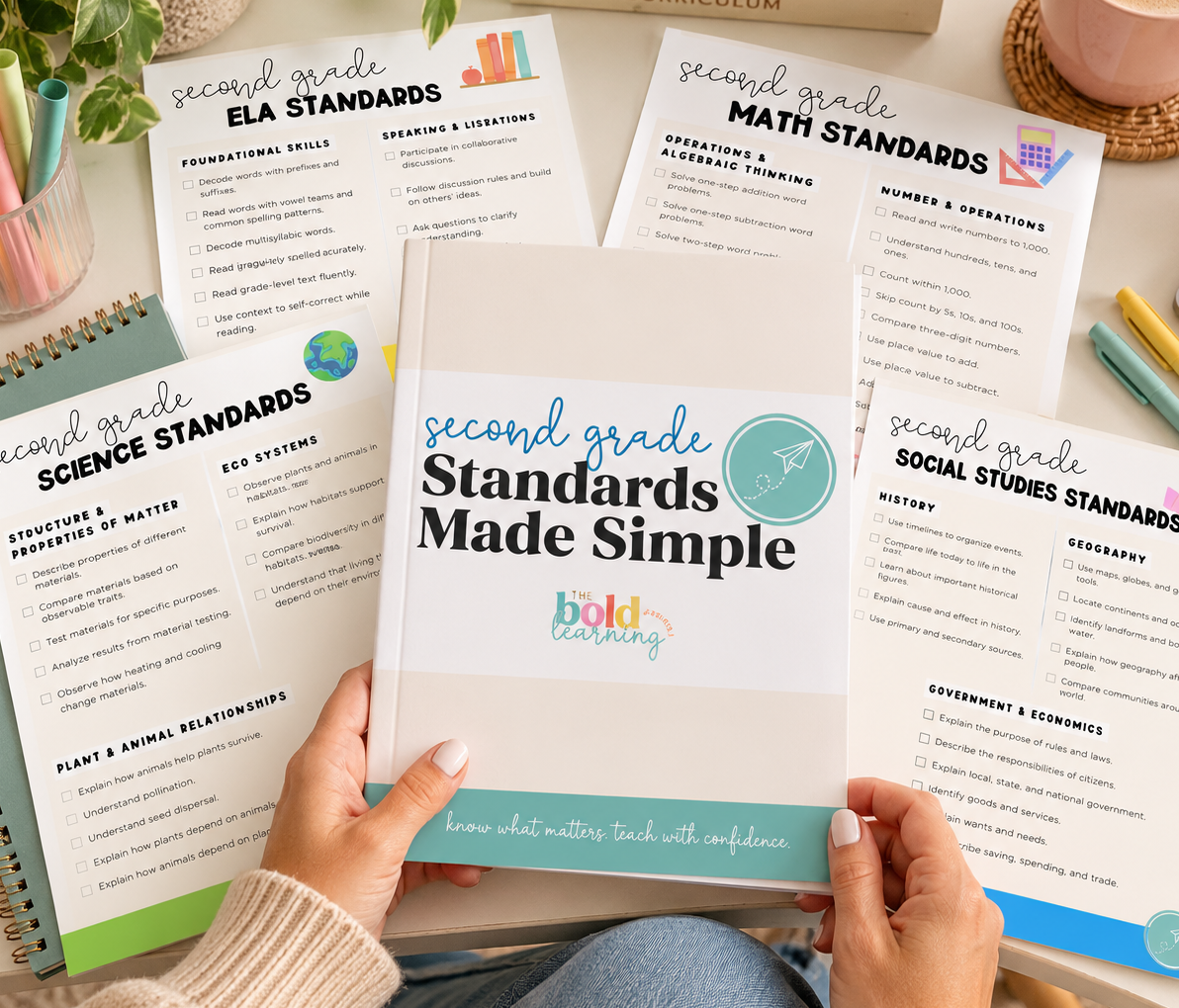
So I created Standards Made Simple.
I took grade-level learning expectations and turned them into something designed for parents to actually use.
Not another curriculum.
Not another thing you have to finish.
Not a rigid schedule telling you what your homeschool should look like.
Just a simple tool that helps you answer: What matters at this grade level? You can use it to see what you've already covered, notice skills you may want to revisit, identify possible gaps, and feel more confident about where you're headed next.
And because I believe homeschool families should be able to access this information without paying for another resource...
Standards Made Simple will always be free.
You Don't Have to Teach Everything
There will always be another book you could read.
Another project you could do.
Another curriculum someone swears changed their homeschool.
Another Pinterest activity you could prep at 10 p.m.
Another thing your child could learn.
But homeschooling isn't about cramming every possible piece of information into childhood. We're building foundations. We're helping our kids become readers, thinkers, creators, problem-solvers, question-askers, and lifelong learners.
So if you've been lying awake wondering:nAm I doing enough? Start smaller. Know what matters. Pay attention to your child. Notice progress. Identify the gaps. Teach what comes next. And leave some room for rabbit trails, messy projects, library stacks, backyard discoveries, questions you don't know the answer to yet, and all the learning you never could have scheduled.
Because sometimes being “on track” looks a lot less like following someone else's path and a lot more like confidently knowing where your child is headed.
Keep wondering. Keep learning. Make it bold.

Comments