New to Homeschooling? Start Here: A Simple Guide for Your First Year
So, you're homeschooling. Maybe you've been planning this for years. Maybe traditional school stopped working for your child. Maybe you've spent the last six months researching every homeschool philosophy known to mankind. Or maybe you made the decision approximately five minutes ago and currently have 37 curriculum tabs open on your computer.
Either way, welcome!
Starting your first year of homeschooling can feel exciting and freeing—and also like someone handed you responsibility for your child's entire education and forgot to include the instruction manual.
Suddenly, you're asking questions you never thought you'd need to answer:
What curriculum should I buy?
How many hours should we homeschool?
What subjects am I supposed to teach?
Do we need a schedule?
How do I know if they're learning enough?
What if I mess this up?
Before we get into any of that, here's what I want you to know: You do not have to have your entire homeschool figured out before you begin. Your first year isn't about creating the perfect homeschool. It's about discovering your homeschool.
And you can do that one step at a time.
Step 1: Know Your State's Homeschool Requirements
Before choosing curriculum or designing the world's cutest homeschool room, start with the boring-but-important part: Find out what your state actually requires.
Homeschool laws and requirements vary depending on where you live. Your state may have requirements involving things like notification, attendance, instructional hours or days, subjects, assessments, or recordkeeping. So don't rely on what another homeschool mom on Instagram says she does—especially if she lives in a different state.
Find reliable, current information for your state and make a simple list of the requirements that apply to your family. That's your foundation. And here's an important distinction: A legal requirement and a homeschool preference are not the same thing. You may be required to keep certain records. You are not automatically required to use the curriculum everyone in your Facebook group loves.
Separating those two things can remove a surprising amount of pressure.
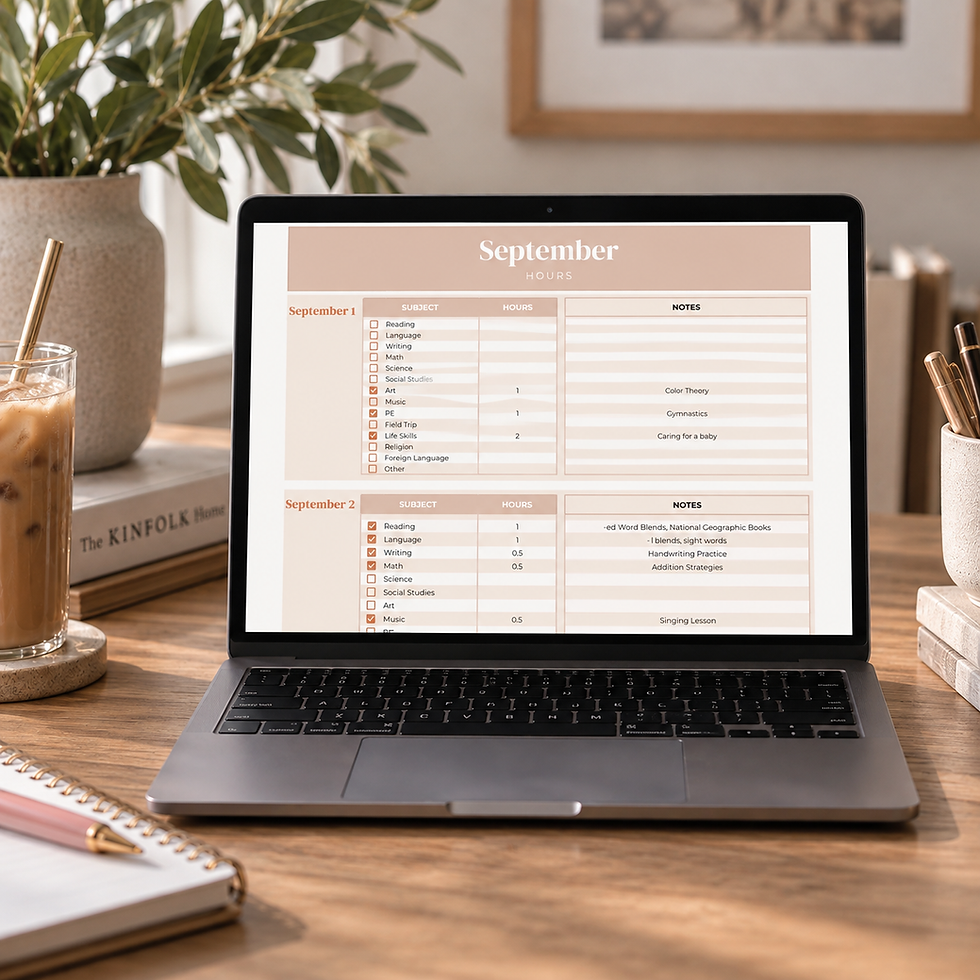
If you're looking for a simple and effective way to track your child's hours, check out our Homeschool Hours Tracker. No matter where you live or what your state requires, this resource is a simple tool to record your child's progress and is easily editable to fit the needs of your homeschool.
Step 2: Figure Out What Your Child Actually Needs to Learn
Once you know the legal requirements, the next question is usually: Okay...but what am I supposed to teach?
This is where many new homeschool parents immediately start curriculum shopping. I'd actually wait. Before deciding how you're going to teach something, get a general idea of what your child needs to learn.
Look at the major skills and concepts typically associated with your child's grade level. For example, you might look at expectations in:
Reading and Language Arts
Math
Science
Social studies
Other subjects required where you live
This doesn't mean your child has to perfectly match a grade-level checklist. And it doesn't mean you need to recreate public school at home. It simply gives you a map. You can look at it and say:
We already know this.
We're working on this.
Oh—we haven't covered this yet.
They're not ready for this one yet.
They are WAY beyond this one.
That's useful information. It's also exactly why I created Standards Made Simple: to take complicated grade-level standards and translate them into something homeschool parents can actually understand and use.
Think of standards as your destination, not the directions you have to take to get there.
Step 3: Choose Curriculum After You Know What You Need
And now we can talk curriculum. Here's the first thing I'd tell any new homeschool parent:
There is no perfect homeschool curriculum.
I know. I wish there were too. It would save us all approximately 700 hours of Googling.
A curriculum can be wonderful and still not work for your child. Another can have gorgeous Instagram photos and make both of you miserable by October. When you're choosing curriculum, think about your actual child and your actual family.
Does your child enjoy listening to stories?
Do they need movement?
Do they love worksheets?
Do worksheets cause immediate dramatic collapse onto the table?
Do they learn by building and touching things?
Do they need short lessons?
Do you need something open-and-go?
Do you enjoy planning?
How much independent work can your child realistically handle?
And—this part matters—what can you realistically maintain?
The best curriculum isn't necessarily the most rigorous, popular, expensive, beautiful, or comprehensive. It's one that helps your child learn and that you can actually use consistently.
And you don't have to buy every subject from the same company. Mix and match. Use curriculum where it helps. Use library books. Use documentaries. Use projects. Use field trips. Use games. Use real life. Your homeschool does not need to arrive in one giant cardboard box.
Step 4: Don't Recreate a Seven-Hour School Day at Home
This is one of the biggest first-year mindset shifts. School and homeschool are structurally different. A classroom teacher may be responsible for 20 or 30 students. There are transitions, attendance, classroom management, lunch, assemblies, lining up, distributing materials, collecting materials, helping multiple students, and dozens of other things happening throughout the day.
At home, you're working with far fewer children. That changes things.
So if your formal lessons don't take from 8:00 a.m. until 3:00 p.m., that doesn't automatically mean you aren't doing enough. Your homeschool day may include concentrated academic lessons alongside reading, chores, cooking, outside time, projects, music, art, errands, conversations, field trips, hobbies, and independent exploration.
Learning doesn't suddenly stop because nobody is sitting at a desk. Which brings us to...
Step 5: Create a Rhythm Before You Create a Perfect Schedule
You absolutely can have a detailed homeschool schedule. Some families thrive on one. But especially during your first year, I'd start with a rhythm.
Instead of:
8:00 Reading
8:30 Math
9:15 Grammar
9:45 Science
Try something more flexible:
Morning: breakfast → get ready → reading + math
Midday: lunch → outside/movement → science or social studies
Afternoon: projects → independent reading → hobbies/activities
Or maybe your family works best doing almost everything before lunch. Or you have a toddler who naps at 1:00 and that's when your older child can finally concentrate. Or you homeschool four days a week. Or Dad works nights. Or Wednesdays are always your co-op day.
Your schedule should serve your family. Your family should not spend the entire year serving your schedule. Give yourself permission to experiment.
Step 6: Remember That Real Life Counts
This is one of my favorite parts of homeschooling. Learning doesn't have to stay inside a workbook.
If your child helps double a recipe, there's math happening. If they compare prices at the grocery store, there's math and financial literacy. If they plant a garden, they're encountering science. If they write a letter to Grandma, they're writing for an actual audience. If they research an animal they found in the backyard, they're reading, researching, observing, and asking questions. If they plan how to build something and their first design doesn't work? Hello, engineering.
This doesn't mean every trip to Target needs to become a twelve-page interdisciplinary lesson plan. Please don't do that to yourself. It simply means we can recognize learning when it naturally happens.
Some of the richest learning experiences won't look very much like school. And that's okay.
Step 7: Keep Simple Records
What you legally need to document depends on where you live, so follow your state's requirements first. Beyond that, I'd keep your personal system as simple as possible.
Depending on your needs, that might include:
Attendance or homeschool hours
Books your child has read
Curriculum you're using
Skills you've covered
A few samples of your child's work
Field trips and educational experiences
Notes about progress or areas that need more work
You don't need to document every educational conversation you've ever had. You're looking for enough information to meet your obligations and help you see the bigger picture of your child's year. And seeing that bigger picture can be incredibly reassuring. On a random Wednesday, it might feel like you accomplished absolutely nothing. Six months later, you can look back and realize: Wow. Look how much they've grown.
Step 8: Expect to Change Something
I'm going to save you some suspense. Something you choose this year probably won't work.
Maybe it'll be your schedule. Maybe it'll be math. Maybe it'll be the elaborate morning basket you were positive would become a cherished family tradition, but everyone actually hates it.
Change it. Switch curriculum. Move math to the afternoon. Stop doing five worksheets when one demonstrates mastery. Take Fridays outside. Read on the couch. Put the workbook away for a week and try something hands-on.
Changing something that isn't working is not failing at homeschooling. It's one of the advantages of homeschooling. You can respond to the child in front of you.
Step 9: Don't Compare Your Beginning to Someone Else's Homeschool
This one can sneak up on you. You'll see the beautiful homeschool room. The color-coded schedule. The eight-year-old reading The Hobbit. The nature journals. The sourdough. And somehow there are always chickens.
Meanwhile, you're searching the couch cushions for the math book while somebody announces they can't find a pencil even though you purchased 96 of them in August.
Welcome to homeschool.
Take ideas from other families. Learn from them. Be inspired. But don't mistake someone else's homeschool for the standard yours has to meet.
Your children are different. Your family is different. Your season is different. And what works beautifully in one home might be completely wrong for yours.
Step 10: Pay Attention to Your Child
This may be the most important one. Curriculum can give us lessons. Standards can give us direction. Schedules can give us structure.
But your child gives you information none of those things can.
Watch them.
What makes them curious?
Where do they light up?
What consistently frustrates them?
What are they avoiding?
What do they talk about long after the lesson ends?
What questions keep coming?
What are they ready for?
Where do they need more time?
You aren't just delivering curriculum. You're teaching a person. And homeschooling gives you the incredible opportunity to build learning around that person.
What Your First Year Actually Needs
If I could sit across the table from every brand-new homeschool mom, I wouldn't hand her a 47-page checklist. I'd give her this:
Know your requirements.
Know what your child needs to learn.
Choose a few good tools.
Create a simple rhythm.
Pay attention to your child.
Adjust when something isn't working.
Leave room for curiosity.
That's enough to start. You do not need your fifth-grade curriculum selected while your child is in first grade. You don't need the perfect homeschool room. You don't need every educational philosophy figured out. You don't need to know exactly what your homeschool will look like three years from now.
You just need to know what you're doing next. And then you learn alongside your kids.
Your Homeschool Is Allowed to Look Different
That's the biggest thing I want you to take into your first year. Homeschool isn't an opportunity to build a tiny version of school inside your house. It's an opportunity to ask:
What could learning look like for our family?
It might look like books piled across the kitchen table. Math manipulatives scattered across the floor. A museum on Tuesday morning. A science experiment that absolutely did not go according to plan. A child becoming obsessed with ancient Egypt for three weeks. A lesson that takes ten minutes. Another conversation that lasts an hour. A day when you throw out the plan entirely because something better caught their attention.
There will be days when homeschooling feels incredible. There will also be days when everyone is cranky and you're Googling “can I homeschool without teaching long division?”
Neither kind of day defines your homeschool. You're building something over time. So start simple. Notice what works. Change what doesn't. And don't be afraid to make learning look a little different.
Keep wondering. Keep learning. Make it bold.

Comments